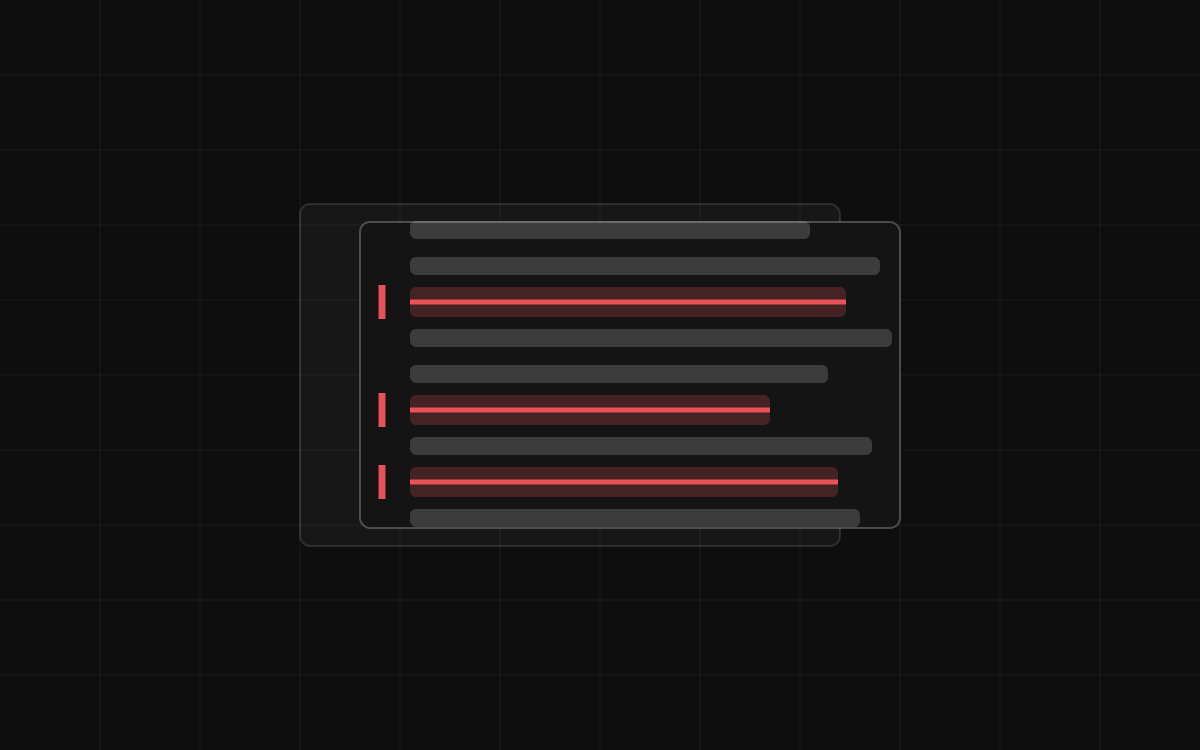
The contract is already marked up when the lawyer opens it.
A two-partner commercial firm. An in-house department of five. Three solo Rechtsanwälte. A general counsel who is the entire legal function of a 300-person company. They are not behind on law. They are behind on contracts as objects — files that arrive, move, change and get lost.
A contract arrives as an attachment called Vertrag_final_final_v3(2).docx. Somebody replies with tracked changes from a version that was already superseded. Three weeks later a deadline that lived only in that document passes unnoticed. Nobody can say which version was signed. The lawyer spends the evening doing archival work with a law degree.
- Intake: pulling contracts out of the mailbox the moment they arrive
- Naming and versioning to one convention, permanently, with the lineage kept
- Extraction: parties, dates, term, notice periods, governing law, liability caps, auto-renewal
- The deadline diary — every date in every contract, surfaced before it matters
- Comparing an incoming draft against the firm’s own playbook and marking the divergences
- Chasing the counterparty who has not returned the draft, and the internal signatory
- Filing to the DMS correctly, first time
- Answering "where is this contract, and which version is current?" instantly
- Whether a clause is acceptable
- What to concede
- Advice
- Signature
- The intake
- A monitored mailbox. Every attachment is identified, versioned, linked to its matter and its predecessor, and filed. The final_final_v3(2) problem disappears in week one, and it is the change people notice first.
- The extraction sheet
- One structured record per contract, with every field carrying a pin back to the exact page and paragraph it came from. Nothing is asserted without a location, because an unverifiable extraction is worse than no extraction — it looks like knowledge.
- The playbook comparison
- The firm’s positions, written down once, properly. This is the hardest and most valuable week of the project, because most firms have never written theirs down. Then each incoming draft is marked against it.
- The first-pass markup
- The centre of the system. A Word document with tracked changes where every single suggestion carries a reason attached as a comment: which playbook position it comes from, or which risk it addresses. The lawyer opens it in Word — their own tool, not mine — and accepts or rejects each one by hand.
- The diary
- Dates extracted into the calendar with escalating reminders. This is the piece with the highest raw value, because a missed notice period is a claim.
No legal judgement, ever, and no output leaves the building unread.
No advice, to anyone, at any point, internal or external. No auto-send to a counterparty. No clause redrafted without a stated reason the lawyer can evaluate. Every extraction pinned to its source so verification takes four seconds. There is no "accept all" — I was asked to build one and refused.
Alongside that, the constraints that make it usable at all in Germany: DSGVO compliance with an AV-Vertrag in place, EU data residency, no training on client content, privilege preserved, a full audit trail, and a documented answer to the Kammer question "who did this and can you show me?" A legal AI system without an audit log is not deployable, whatever it can do.
Time from arrival to filed and named. "Where is this contract" answered in seconds. Missed deadlines: zero. And the one the partners cite — evenings not spent on version archaeology.
Bespoke, high-value, one-off negotiation work. There is no playbook there because there is no repetition, and a first-pass markup on a genuinely novel deal is noise dressed as help.
Two weeks of writing the playbook. Then eleven minutes per contract instead of forty.
The version problem alone was costing us evenings — Vertrag_final_final_v3 and nobody able to say which one was signed. He shipped only the intake and the filing in the first month and then stopped, which I found strange until I understood it was deliberate. The markup came later and every single suggestion arrives in Word with a reason attached, and I accept or reject each one myself. He was asked for an accept-all button and refused, and I would not have kept working with him if he had built it.
We are five people doing the legal work of a three-hundred-person company. What changed my week is the diary — every notice period in every contract is now a date I will be told about, and before this we had missed one and it was expensive. The extraction pins every field back to the page it came from, so checking it takes four seconds rather than trusting it. The audit trail was non-negotiable for us and it was the first thing he asked about, not the last.
Tell me what your week looks like.
I'll tell you honestly which parts you can hand over — and which you can't.